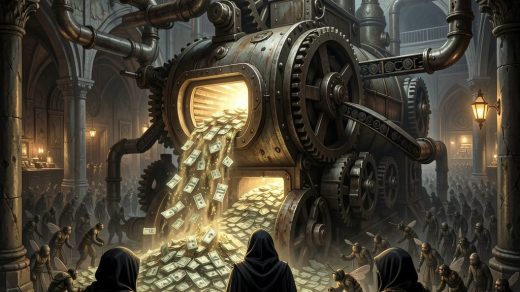
The Second Pillar of the Kingdom
The second pillar supporting the Plastic King’s kingdom is money.
Not a little money.
Not a comfortable amount of money.
An amount of money large enough to make accountants develop spiritual beliefs.
The Plastic King enjoys both legal and illegal sources of income. While the legal side helps maintain a respectable public image, it is the darker side of the ledger that supposedly generates the real wealth.
As the old saying almost goes:
“A clean suit looks even cleaner when nobody asks where the money came from.”
The Business of Peace, One Weapon at a Time
According to the story, one of the Plastic King’s most profitable activities is acting as a middleman in arms deals.
Governments cannot always sell weapons directly to militias and other groups without attracting unwanted attention.
That is where the Plastic King enters the picture.
Why get your own hands dirty when you can hire someone else’s hands?
The arrangement is simple.
One side wants weapons.
The other side wants plausible deniability.
The Plastic King wants a commission.
Everyone leaves happy except the people caught in the middle of the conflict.
The article raises an uncomfortable question:
If a person helps move weapons that contribute to violence, conflict, and the deaths of innocent people, can he still present himself as a servant of light?
Or is he simply a businessman who discovered that morality has excellent profit margins when used as advertising?
“Feed the poor in the morning, arm a militia in the afternoon, and call it balance.”
Selective Morality
The Plastic King often presents himself as a force for good.
And to be fair, compared to some of the darker factions in Mickey Mouse Land, he appears less extreme.
He claims not to engage in psychological attacks.
He claims not to exploit children.
He claims not to participate in some of the activities associated with the darker cults.
Wonderful.
The problem is that he knows the groups that do these things.
And he does nothing to stop them.
This creates a fascinating moral position:
“I didn’t commit the crime. I merely watched it happen and continued with my day.”
Some people call that neutrality.
Others call it convenience.
The Plastic King seems to prefer the first definition.
The Price of Looking Virtuous
The greatest strength of the Plastic King may not be his money itself.
It may be his ability to spend that money on appearances.
Charity creates admiration.
Public generosity creates loyalty.
Religious symbolism creates trust.
Meanwhile, the less glamorous parts of the business remain hidden behind a carefully maintained image.
The result is a figure who appears to many as a benefactor, while critics see something very different.
Which interpretation is correct?
That is for the people of Mickey Mouse Land to decide.
But one question remains difficult to ignore:
“If a man profits from suffering while presenting himself as a savior, is he a light worker—or simply a very sophisticated salesman?”
Until next time, we continue exploring the pillars that hold up the Plastic King’s empire.